Apex Trader Funding rules after the 2026 change
On 1 March 2026 Apex retired its old evaluation and replaced it with two: an EOD trailing drawdown evaluation, where the threshold is recalculated once a day at 4:59:59 PM ET, and an intraday trailing drawdown evaluation, where it follows your peak including open profit. On a 50K, both ask for $3,000 with a $2,000 drawdown, inside 30 calendar days, flat by 4:59 PM ET.
A note on sources: Apex blocks visitors from some countries, including the one we checked from. Every number here comes from Apex's own help-centre pages as indexed by search, not from a full read. Check the firm's current rules in your dashboard before you rely on any figure.
- Profit target
- $3,000
- Trailing drawdown
- $2,000, EOD or intraday version
- Daily loss (EOD version)
- $1,000, pauses the session
- Contracts (intraday version)
- 6
- Minimum days
- None
- Time limit
- 30 calendar days, then 7 days to activate the PA
- Consistency
- None in evaluation, 50% in the PA
- Trading day
- 6 PM to 4:59 PM ET, no overnight
Numbers by account size
| 25K | 50K | 100K | 150K | |
|---|---|---|---|---|
| Target | $1,500 | $3,000 | $6,000 | $9,000 |
| Trailing drawdown | $1,000 | $2,000 | $3,000 | $4,000 |
| Daily loss, EOD version | $500 | $1,000 | $1,500 | $2,000 |
| Contracts, intraday version | 4 | 6 | 8 | 12 |
Apex prices change constantly with promotions, and we could not load its pricing page, so check the price on Apex's site. Accounts bought before 1 March 2026 run on Legacy rules, which differ.
EOD vs intraday trailing, side by side
| EOD version | Intraday version | |
|---|---|---|
| Threshold at start | $48,000 | $48,000 |
| While trade is +$1,500 | $48,000 | $49,500 (follows open profit) |
| After close at +$500 | $48,000 until 4:59 PM ET | $49,500 |
| Next morning | $48,500 | $49,500 |
Same trade, same day, and the intraday account has $1,000 less room the next morning. On the intraday version every open high counts, so a winner you let breathe and then give back costs drawdown you never booked as profit.
A trader risking $250 a trade on the EOD 50K has four full stops before the $1,000 daily pause and eight before the trailing threshold. On the intraday version, size for the fact that open profit tightens the line.
Where the threshold stops trailing depends on your platform's data feed: Apex's pages describe it stopping at a fixed level on Rithmic and WealthCharts, and trailing on Tradovate. Confirm your stop level in the dashboard.
The Performance Account and payouts
- Consistency: in the PA, your largest profitable day must be under 50% of net profit since the last approved payout.
- Qualifying days: 5 days meeting a minimum daily profit. On the EOD 50K that is $250 a day; on the intraday 50K, $200.
- Safety net: the drawdown plus $100. Only profit above it can be withdrawn. Minimum request $500.
- Payout count: a maximum of 6 payouts per PA. Apex's pages show a 100% split.
- Automation: AI, bots, algos, fully automated systems and HFT are banned on PA and Live accounts. No copy-trading service may manage them.
Our Apex Trader Funding review goes deeper on costs and payouts.
Where Apex accounts fail
The 30-day clock counts calendar days, not trading days. Traders who wait for the perfect setup in week one often force trades in week four.
An open high lifts the threshold. Giving back a big open winner can leave you with almost no room even when the trade closes green.
All trades must be closed and orders cancelled by then. A forgotten resting order counts.
Pacing a 30-day Apex evaluation
Thirty calendar days is about twenty-one trading sessions. On a 50K with a $3,000 target, that is roughly $150 a session on average. Set your per-trade risk so a normal day's target is one or two winners: $150 risk at 2R makes $300 per winner, so two winners on a good day and a loss on a bad day keeps you on pace.
On the EOD version, keep each day inside $500, half the $1,000 daily pause. On the intraday version, take partial profits on runners so an open high does not lift the threshold further than your closed result.
If you are behind pace at day 20, do not double size. The 30-day clock resets nothing if the drawdown takes the account first.
Track Apex in the RB journal
The journal has Apex presets for the evaluation and the PA, last verified before the March 2026 change, so check the numbers against your dashboard.
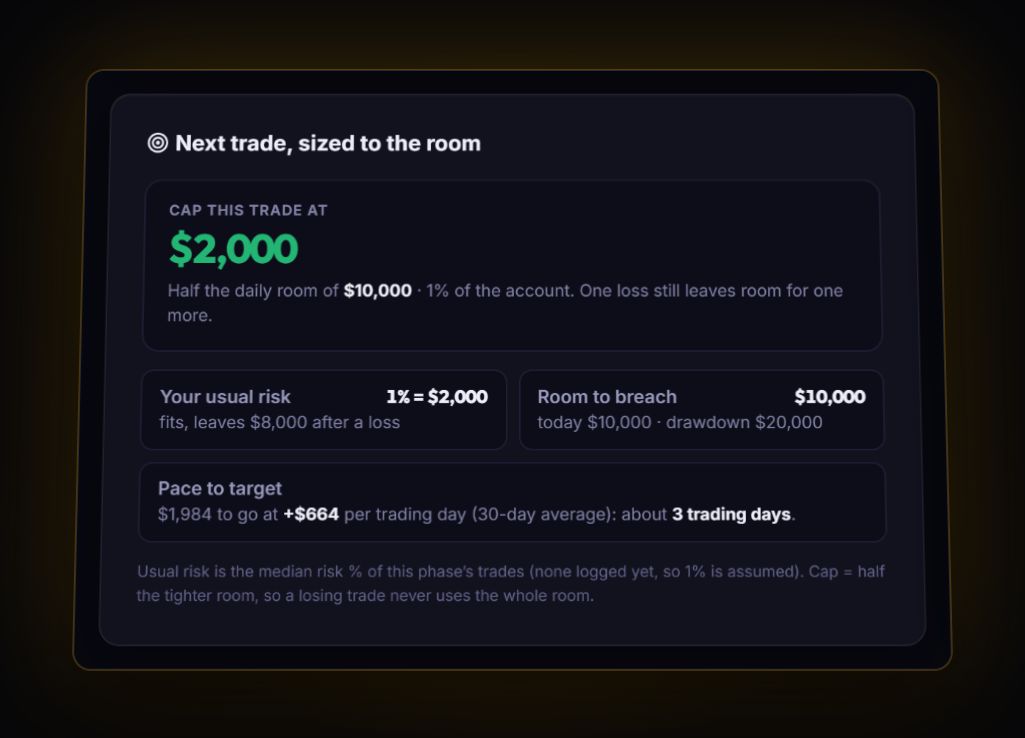
- Add a prop account in Risk Manager and choose Apex Trader Funding, Evaluation. Edit the target and drawdown to match your size and version.
- Futures platforms do not run the RBSync EA, so import your fills from a CSV export of your platform (the journal reads NinjaTrader and Tradovate exports, and the generic CSV mapper handles others).
- The journal trails on live equity, which matches the intraday version and is stricter than the EOD version, so it warns early rather than late.
- Set a reminder for day 20 of your 30. If you are not near the target, cut size rather than raise it.
- In the PA, log your best day and check it against 50% of profit since your last payout before you request.
See our Apex journal page for the full walkthrough.
Questions traders ask about Apex
What changed at Apex in March 2026?
On 1 March 2026 Apex retired its previous evaluation and PA versions and introduced EOD trailing and intraday trailing drawdown accounts. Accounts bought earlier stay on Legacy rules.
How long do I have to pass an Apex evaluation?
30 calendar days, according to Apex's help centre. After passing, you have 7 days to activate the Performance Account.
Does Apex have a consistency rule?
Not in the evaluation. In the Performance Account, your largest profitable day must be under 50% of net profit since your last approved payout.
Sources
- Apex help, EOD evaluations
- Apex help, intraday trailing evaluations
- Apex help, EOD payouts
- Apex help, 50% consistency
Rules on this page come from Apex Trader Funding's official website and help centre. Last checked: 8 October 2026. Where we could not verify a rule, we say so and ask you to check the firm's current rules.
Know your room before you click
Add your Apex account and the journal shows trailing room, daily room and days left on the clock.
Start free, no card