FTMO rules: the numbers that decide a pass or a fail
FTMO runs two challenges. The 2-Step asks for 10% then 5%, with a 5% daily loss and a 10% max loss that never moves. The 1-Step asks for 10% in one go, with a tighter 3% daily loss, a 10% max loss that trails your best end-of-day balance, and a Best Day rule. Both daily limits reset at midnight Prague time (CE(S)T) and are checked against equity, so open trades count.
Below are the rules side by side, a worked example on a $100,000 account, and the specific ways traders run out of room at FTMO.
- Profit target
- 10% (Challenge), 5% (Verification)
- Max daily loss
- 5% of initial capital, off the 00:00 CE(S)T balance
- Max loss
- 10% static ($90,000 floor on $100K)
- Minimum days
- 4 trading days per phase
- Time limit
- None
- Consistency
- None on the 2-Step
- Split
- 80%, up to 90% with scaling
- First reward
- From day 14 after your first trade
2-Step and 1-Step side by side
| Rule | 2-Step | 1-Step |
|---|---|---|
| Target | 10% then 5% | 10% |
| Daily loss | 5% of initial capital | 3% of initial capital |
| Max loss | 10%, static | 10%, trails highest end-of-day balance |
| Minimum days | 4 per phase | None listed |
| Best Day rule | No | Best day max 50% of Positive Days' Profit |
| Split | 80%, 90% via scaling | 90% |
| Sizes | $10K to $200K | $10K to $200K |
Both run with no time limit. Prices are shown in euros at checkout and change with promotions, so we do not list them here: check the current price on FTMO's site.
How the daily loss is really calculated
At 00:00 CE(S)T, midnight in Prague, FTMO takes your balance and subtracts 5% of your initial capital (3% on the 1-Step). Your equity, including open trades, swaps and commissions, may not touch that number until the next midnight. On day one the starting figure is the initial capital.
You closed yesterday at $102,400. Today's floor is $102,400 minus $5,000 = $97,400. You risk 1% of the initial balance, $1,000, per trade.
| Event | Equity | Room to floor |
|---|---|---|
| Day opens | $102,400 | $5,000 |
| Two losers at full stop | $100,400 | $3,000 |
| Third trade open, $1,800 against you | $98,600 | $1,200 |
| Fourth trade opened on top | Room left is smaller than one full 1% stop | Breach risk |
Two things change the picture. First, a green morning does not lift today's floor; it only moves at the next midnight. Second, the floor follows the closed balance down: close today at $99,000 and tomorrow's floor is $94,000, while the static $90,000 max loss sits underneath. A 1% trader on the 2-Step has five full losses of daily room. On the 1-Step, with 3%, the same trader has three.
The 1-Step trailing max loss and Best Day rule
On the 1-Step, the 10% max loss is recalculated every midnight as your highest end-of-day balance (or the initial capital, if higher) minus 10% of initial capital. It only rises. Close a day at $104,000 on a $100,000 account and your floor becomes $94,000 for good.
The Best Day rule says your best day may not be more than 50% of your Positive Days' Profit, the sum of all profitable days. Going over it is not a breach. You simply keep trading until the ratio is back at 50% or lower, both to pass and to qualify for a reward. If your best day is $6,000, your profitable days need to add up to at least $12,000.
News, weekends, EAs and rewards
- News: no restriction during the Challenge or Verification. On a funded Standard account you may not open or close trades on targeted instruments from 2 minutes before to 2 minutes after selected releases, and a stop or target filling inside that window counts. Swing accounts are exempt.
- Weekends: on a funded Standard account, close positions before the weekend market close. No restriction in evaluation or on Swing, which runs at up to 1:30 leverage instead of 1:100.
- EAs: allowed. FTMO warns that a third-party EA many other traders run can clash with its capital allocation rules.
- Rewards: request from the 14th day after your first trade, all positions closed. The 2-Step fee is refunded with the first reward.
- Scaling: after a 4-month cycle with at least 10% net profit and 2 processed rewards, the balance grows 25% and the split moves to 90%, up to $2,000,000.
FTMO's copy trading position was not stated on the pages we read, so check the firm's current rules before you copy between accounts. For the deep dive on every threshold, read our FTMO rules explained guide.
How traders fail FTMO's rules
A green morning feels like a cushion, but the floor was fixed at midnight. Traders who think they have $7,000 of room after a $2,000 morning still only have $5,000 from the opening balance, and lose the account giving back the gain plus a normal loss.
The 1-Step daily loss is 3%, so a size that gave you five losses of room now gives you three. Many 1-Step breaches are simply 2-Step habits.
A single $7,000 day on a $100,000 1-Step does not fail you, but it means your other profitable days must add another $7,000 before you pass, which pushes most traders into forcing trades.
A simple risk budget for an FTMO account
Work backwards from the limit, not forwards from the target. On a $100,000 2-Step the daily room is $5,000 and the total room is $10,000. If you decide that no single day may use more than half of the daily room, your working daily stop is $2,500. At 0.5% risk per trade that is five losing trades, which is more than most traders take in a session.
The target looks after itself at that size. Ten percent is $10,000; at 0.5% risk and a 2R average winner you need ten net winning trades over the phase, with no time limit to do it in. On the 1-Step, halve the daily stop again, because a 3% limit gives you $3,000 of room and the trailing max loss tightens as you make money.
Write the plan into your journal before the phase starts, then check each day's result against it, not against how you feel.
Track FTMO in the RB journal
The RB journal's Prop Tracker, inside Risk Manager, has FTMO presets for the 2-Step, the 1-Step and Swing, with the limits and source link already filled in.
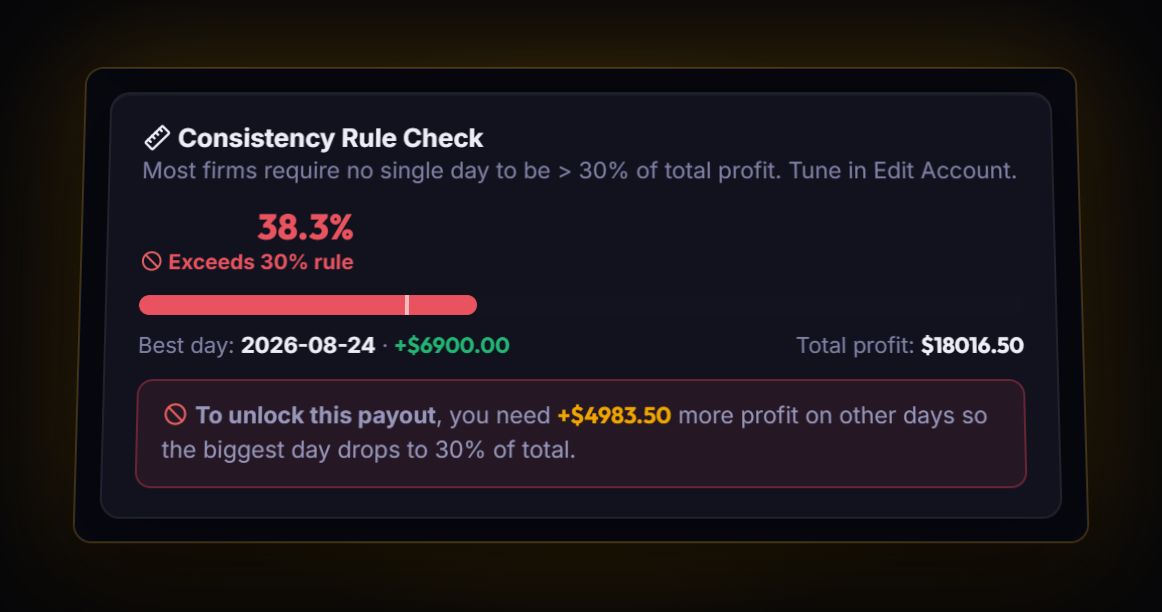
- Open Risk Manager, add a prop account, and pick FTMO, Standard 2-Step (or 1-Step or Swing) and your size.
- Log trades as you take them, or sync MT4 and MT5 live through the RBSync EA, so the tracker sees your equity.
- Read Daily room left before each entry. Size the trade so one full stop uses no more than a quarter of it.
- Watch Room Left on the max loss. On the 1-Step the journal trails it on live equity, stricter than FTMO's end-of-day trail, so it warns you early, never late.
- If an account ends, mark it breached with the reason. Your firm history then shows spend against payouts, and which rule keeps costing you.
Our FTMO trading journal page walks through the setup screen by screen.
Questions traders ask about FTMO
Does FTMO's daily loss limit count open trades?
Yes. The limit is checked against equity, which includes floating profit and loss, swaps and commissions. A losing position you have not closed can breach the account.
What time does the FTMO daily loss reset?
At 00:00 CE(S)T, midnight in Prague. The new floor is that moment's balance minus 5% of initial capital on the 2-Step, or 3% on the 1-Step.
Is FTMO's max loss trailing?
On the 2-Step it is static at 10% below initial capital. On the 1-Step it trails your highest end-of-day balance and never moves down.
Does breaking the 1-Step Best Day rule fail the account?
No. FTMO treats it as a condition to meet, not a breach. You keep trading until your best day is 50% or less of your Positive Days' Profit.
Sources
- FTMO, Trading Objectives
- FTMO FAQ, can I trade news?
- FTMO FAQ, how do I withdraw my profits?
- FTMO, Reward growth and Scaling Plan
Rules on this page come from FTMO's official website and help centre. Last checked: 8 October 2026. Where we could not verify a rule, we say so and ask you to check the firm's current rules.
Know your room before you click
Pick the FTMO preset and the journal shows today's floor, your daily room and your max loss room before every trade.
Start free, no card