The math behind it
Open, unrealised losses usually count toward the limit, and so do commissions and swaps. Check both on your firm's rule page.
An example with numbers
A $100,000 account with a 5% daily limit measured on initial balance: the limit is $5,000. You start the day at $101,200, so the floor is $96,200.
By midday you have closed a loser for −$1,900 and have two open trades, each risking $1,800 to its stop.
Neither open trade breaks any rule on its own. Together they do. If the firm measured 5% of the day-start balance instead, the limit would be $5,060 and the floor $96,140: still a breach. The habit that prevents this is adding up worst-case risk across every open trade before you place the next one.
Mistakes to avoid
- Counting closed trades only. Floating losses on open trades usually count.
- Getting the reset time wrong. If the day resets at a set server time, a trade opened just before it carries its loss into the "new" day.
- Trading right up to the line. A personal limit at about half the firm's leaves room for slippage and a bad fill.
- Forgetting costs. Commission on a big position can be the last $50 that breaches the day.
What the journal does with it
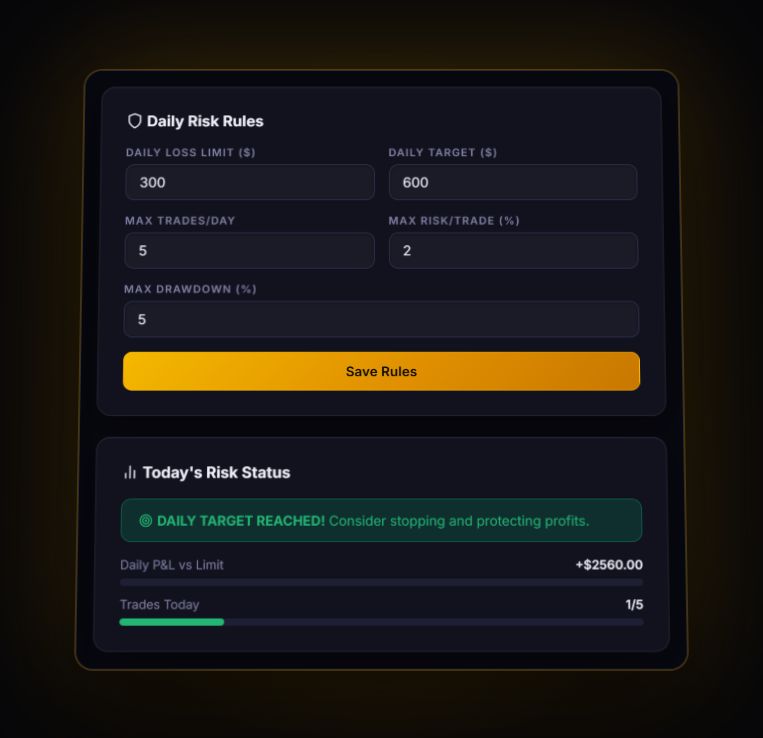
Set a Daily Loss Limit on the account and the journal keeps today's remaining daily-loss room on the live card. A pre-trade daily-loss guard appears when a new trade's worst-case loss would burn a meaningful share of what is left, and if an account does breach you can log the reason (daily loss, max drawdown or consistency) so the pattern shows up later.
See your own Daily Loss Limit from real trades
Stop estimating it in a spreadsheet. Log or sync your trades and the journal keeps the number current after every close.
Start free, no card