Funding rates explained: what holding a perp really costs you
A funding rate is a periodic payment between traders holding a perpetual future. When the rate is positive, longs pay shorts. When it is negative, shorts pay longs. The payment is your position’s notional value times the rate, charged at every funding interval you hold through. The exchange is not the counterparty. It exists to keep the perpetual’s price close to the spot price.
Last checked: 8 October 2026. Exchange menus, fees and rules change, so confirm on the exchange’s own site before you rely on them.
Perpetual futures never expire, so something has to pull their price back towards spot. Funding does it. When too many traders are long and the perp trades above spot, the rate turns positive and longs pay to stay in. That makes holding the crowded side expensive and nudges the price back. For a swing trader, it means a position held for days carries a running cost that never appears on the chart.
The formula you actually need
payment = position notional × funding rate (per interval)
cost of a hold = notional × rate × number of intervalsYou are long 20,000 USDT of notional. Funding is 0.05% every eight hours, positive, so longs pay. You hold for five days, which is 15 intervals.
Cost: 20,000 × 0.05% × 15 = 150 USDT.
Your stop is 1% away, so the trade risks 200 USDT and 1R is 200. Funding alone cost 150 ÷ 200 = 0.75R. The price could move exactly as planned and the trade could still give back three quarters of a risk unit.
The calm baseline is far smaller. Many exchanges anchor funding at 0.01% per eight hours when the market is balanced. That is 0.03% a day and about 10.95% a year of notional, still enough to matter on a position held for weeks. Annualise a rate before you hold: 0.05% × 3 × 365 = 54.75% a year is a very different number from "five hundredths of a percent".
How often each exchange charges funding
| Exchange | Default interval | Notes from the official docs |
|---|---|---|
| Binance | 8 hours | 00:00, 08:00 and 16:00 UTC. Some USDⓈ-M contracts settle every 4 hours. |
| Bybit | 8 hours | Some contracts use 1, 2 or 4 hours; the interval can shorten when the rate hits its cap. |
| OKX | 8 hours | Some contracts use 1, 2 or 4 hours; the interval tightens a step each time the rate hits its cap. |
| Bitget | 8 hours | 00:00, 08:00 and 16:00 (UTC+8). Some coins differ. |
| MEXC | 8 hours | Some pairs settle every 4 hours. |
| KuCoin | Mostly 8 hours | Varies per contract; some have moved to 1 hour. |
| Hyperliquid | 1 hour | Each hour pays one eighth of the computed 8-hour rate. |
| Coinbase (US perp-style futures) | 1 hour | Accrued funding settles to the derivatives cash account on weekdays. |
| Deribit | Continuous | Accrues continuously into session P&L and settles daily. |
Intervals and caps change, and they can differ by contract on the same exchange. Check the contract’s specification page before you hold through funding.
Funding when you are short
Positive funding pays shorts, which tempts people into shorts held "for the funding". Run the numbers the same way: 20,000 short at 0.05% per eight hours earns 10 USDT an interval. A 1% move against you costs 200, twenty intervals of income. Funding is a cost or a bonus on a trade, never the trade itself.
Reading funding as a signal
A high positive rate tells you the long side is crowded and paying up to stay in. That does not mean price must fall, but it does mean a sharp drop would force a lot of leveraged longs out at once. Record the rate at entry in your journal. After fifty trades you can check whether your longs entered at high funding did worse than the rest. That is a question only your own data can answer.
Finding funding in your exports
Funding rarely sits in the trade history. Look for it here:
- Binance: the futures Transaction History, alongside realised P&L and commission.
- Bybit: the Transaction Log of the Unified Trading Account.
- OKX: the Position history download, which has a Funding Fee column. The Trading history download does not.
- Kraken: the derivatives account log, with Funding Rate and Realised funding columns.
- Hyperliquid: the Funding History tab, or the
userFundinginfo request.
Tracking funding in the RB Trading journal
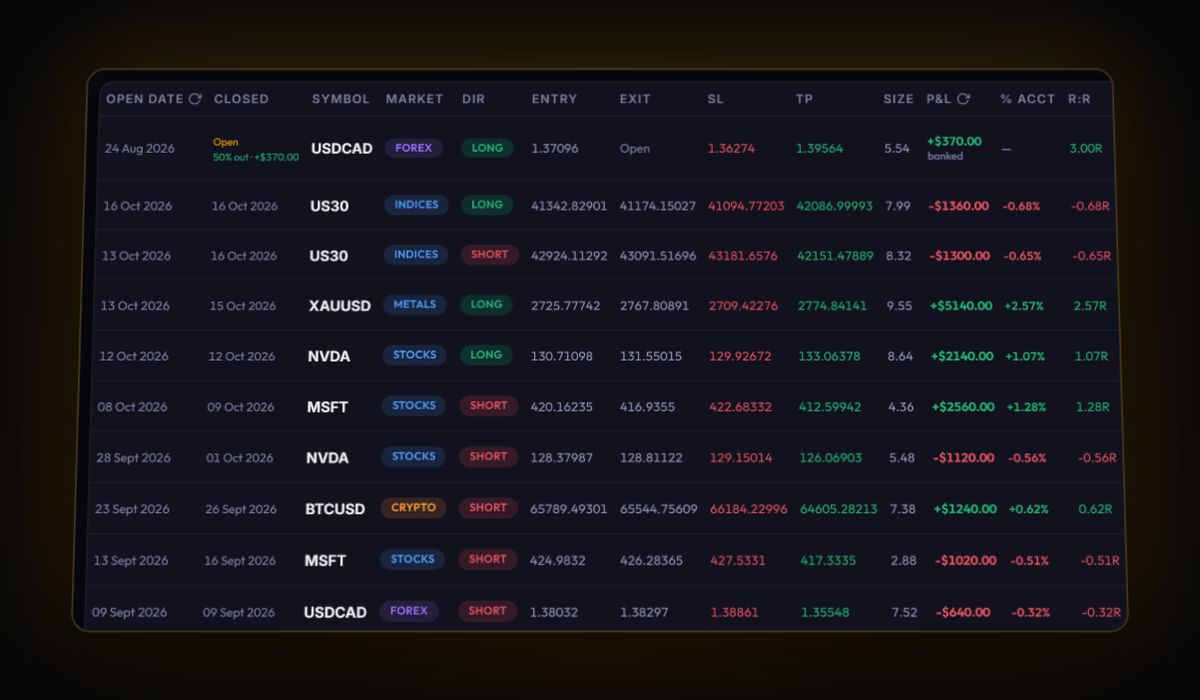
Each account can carry a crypto cost preset. The perp preset uses a 0.01% per eight hours baseline, and you can set a custom rate instead. The journal charges it three times a day, weekends included, with longs paying and shorts receiving, so a trade you log by hand shows its carry cost rather than an optimistic gross number. When you import a closed-trade CSV through the generic mapper, a column headed Swap is read as the carry cost, so you can rename an exchange’s funding column to Swap and the real amounts land on each trade.
Funding rate questions
Who pays the funding rate, longs or shorts?
When the rate is positive, longs pay shorts. When it is negative, shorts pay longs. The exchange passes the payment between traders rather than keeping it.
How do I calculate a funding payment?
Multiply your position's notional value by the rate for each interval you hold through. A 20,000 USDT position at 0.05% per eight hours pays 10 USDT per interval, or 150 USDT over five days.
Is funding charged if I close before the funding time?
On exchanges with fixed funding times, you generally pay or receive only if you hold a position at the funding timestamp. Hyperliquid charges every hour and Deribit accrues continuously, so short holds there still carry some funding.
Sources
Track it in a journal that does the maths
Log the trade once. R, fees and the weighted average entry are worked out for you.
Start free, no card