How to journal crypto futures without leverage lying to you
Journal a perpetual future the same way you journal any trade: entry, stop, size and the money you risk between them. Leverage only decides how much margin the exchange holds, so leave it out of the R calculation. Then subtract the costs crypto adds on top, the taker or maker fee on both sides and funding for every interval you held, and record the net R.
Last checked: 8 October 2026. Exchange menus, fees and rules change, so confirm on the exchange’s own site before you rely on them.
Crypto futures journals go wrong in a predictable way. A trader opens a position at 20x, it moves 2% in their favour, the exchange shows +40% "ROE", and that is the number that goes in the journal. ROE is profit divided by margin, and margin is whatever you chose it to be. Change the leverage and the same trade shows a different ROE. R does not have that problem.
Step one: size from risk, not from leverage
Account: 5,000 USDT. Risk per trade: 1%, so 50 USDT is 1R.
You go long BTC perpetual at 60,000 with a stop at 58,800. The stop is 1,200 away, or 2% of price.
Position notional: 50 ÷ 0.02 = 2,500 USDT, which is 2,500 ÷ 60,000 = 0.04167 BTC.
At 5x leverage the exchange holds 500 USDT of margin. At 10x it holds 250. At 25x it holds 100. In every case, if the stop fills you lose 50 USDT. Leverage changed the margin, not the risk.
So the leverage setting is a margin choice, and your journal should record it as a note, not as part of the result. The one place it does matter is liquidation: too much leverage puts the liquidation price above your stop. That is covered in liquidation versus stop loss.
Step two: count the costs crypto adds
Perpetuals charge a trading fee when you open and again when you close, as a percentage of notional. A stop or market exit pays the taker rate. Funding is exchanged between longs and shorts at fixed intervals while the position is open: every eight hours on many exchanges, every hour on some. On a 1R trade these costs look tiny in dollars and are anything but small in R.
Same trade. You hold it for three days and close at 63,000 with a market order. Taker fee 0.055% per side, funding 0.01% every eight hours, paid by longs.
Gross profit: 0.04167 × 3,000 = 125.00 USDT, which is 2.50R.
Entry fee: 2,500 × 0.055% = 1.38. Exit fee on the larger exit notional: 2,625 × 0.055% = 1.44. Funding: 9 intervals at 0.01% on roughly 2,500 of notional is 2.25.
Net: 125.00 − 1.38 − 1.44 − 2.25 = 119.93 USDT, or 2.40R.
A tenth of an R on one trade. Over two hundred trades a year that is twenty R, which for many traders is the entire year’s edge.
Step three: decide what one trade is
Exchanges export fills, not ideas. If you entered in two clips and closed in three, the export has five rows. Your journal needs one trade with a weighted average entry, a weighted average exit, and an R based on the risk at entry. Add to a winning position later and that is still the same trade, with more risk added at the moment you added it.
What to write next to each futures trade
- Leverage and margin mode, cross or isolated, as a note. Useful for spotting a habit of raising leverage after losses.
- Order type on exit: limit or market. The maker and taker gap adds up.
- Funding paid or received, and the rate when you entered. A crowded long often shows up here first.
- Liquidation price at entry, to confirm it sat beyond the stop.
Which export to bring into a journal
| Export type | One row per | Good for |
|---|---|---|
| Trade history / fills | Execution | Exact prices and fees. Needs pairing into trades. |
| Closed P&L / position history | Closed position | Realised result per trade, often with fees. |
| Transaction log / ledger | Balance change | Funding payments, which rarely appear anywhere else. |
Each exchange page in this section shows where those three live: Binance, Bybit, OKX, Hyperliquid and the others on the crypto hub.
How the RB Trading journal handles crypto futures
- A crypto fee preset per account. Choose Perp futures, 0.055%/side taker + funding 0.01%/8h, Spot exchange, 0.10%/side, a zero-fee venue, or a custom per-side and funding rate. The journal uses it to cost trades you log by hand, and funding is charged three times a day, weekends included, with longs paying and shorts receiving.
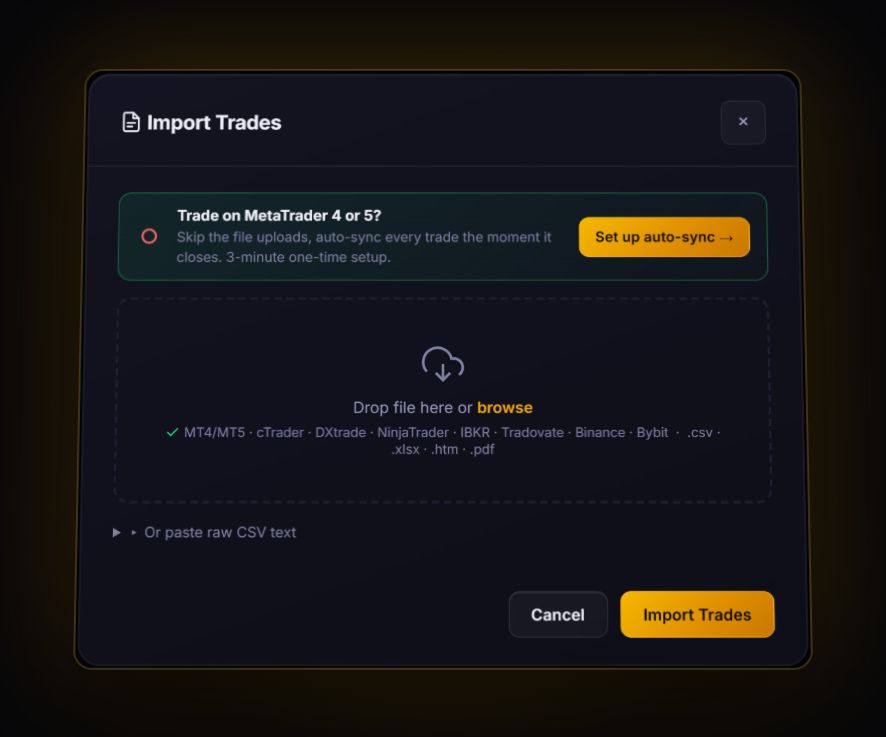
- Fill exports are paired for you. Upload an execution export and the journal pairs buys and sells first in, first out into round trips. Anything left unmatched shows as a currently open position.
- Binance and Bybit headers are recognised. Columns such as Realized Profit, Fee Asset and Order Side mark a file as a crypto export. Other exchanges import through the generic CSV mapper.
- Scale-ins and scale-outs fold into one trade, with R weighted by size across every exit on the risk taken at entry.
There is no live API sync for crypto exchanges. Live sync in the journal is for MT4, MT5 and cTrader. Crypto history comes in by file import.
Crypto futures journal questions
Does leverage change my R on a crypto futures trade?
No. R is the result divided by the money you would lose at your stop, and that depends on position size and stop distance. Leverage only changes how much margin the exchange holds, unless it is high enough to put liquidation before your stop.
Should I record ROE or P&L in my trading journal?
Record P&L net of fees and funding, and R. ROE divides profit by margin, so the same trade shows different ROE at different leverage settings.
How much do fees and funding cost in R?
In the worked example, a 2.50R gross winner became 2.40R after a 0.055% taker fee on both sides and three days of 0.01% funding every eight hours.
Track it in a journal that does the maths
Log the trade once. R, fees and the weighted average entry are worked out for you.
Start free, no card