New here? Read these four in order
Most of the glossary builds on four ideas. Read them in this order and the rest of the pages will make sense quickly.
- R-multiple: measure every trade in units of the risk you took, so different sizes and markets become comparable.
- Expectancy: the average R you earn per trade. It is the clearest single test of whether a strategy works.
- Position sizing: how a risk percentage becomes an order size, so each loss costs what you planned.
- Risk of ruin: how edge and risk per trade combine into the odds of hitting a loss you cannot recover from.
A
Average True Range (ATR)A volatility measure of how far price typically moves per bar.C
Consistency RuleA cap on how much of total profit can come from one day.D
Daily Loss LimitThe most an account may lose in a single trading day. DrawdownThe fall in equity from a peak to a later low.E
EMA (Exponential Moving Average)A moving average that gives more weight to recent prices. ExpectancyThe average amount a strategy wins or loses per trade.F
Funding RateA periodic payment between longs and shorts on perpetual futures.K
Kelly CriterionThe fraction of capital that maximises long-run growth for a given edge.L
LeverageControlling a position larger than the margin put up for it. LiquidationA forced close of a leveraged position when margin runs out. Lot SizeThe number of units one trade controls.M
MAE (Maximum Adverse Excursion)The worst unrealised loss a trade reached before it closed. Max DrawdownThe largest peak-to-trough fall in equity over a period. MFE (Maximum Favourable Excursion)The best unrealised profit a trade reached before it closed.P
PipThe standard unit of price movement in forex. Position SizingChoosing trade size so a stop-out costs a fixed, planned amount. Profit FactorGross profit divided by gross loss over a set of trades.R
R-MultipleA trade result divided by the amount you risked on it. Risk of RuinThe probability a strategy loses down to a set ruin level. Risk-Reward RatioPotential loss to the stop compared with potential gain to the target.S
Scaling OutClosing a position in parts instead of all at once. Sharpe RatioAverage excess return divided by the standard deviation of returns. SlippageThe difference between the expected price and the actual fill. SpreadThe gap between the bid and the ask price. Static DrawdownA loss limit fixed from the starting balance that never moves. Stop-LossAn order that closes a trade at a set price to cap the loss.T
Trailing DrawdownA loss limit that rises as the account makes new highs.W
Win RateThe percentage of closed trades that made money.Why a glossary on a journal site?
Because nearly every term here is a number you can only know from your own trades. A book can tell you what profit factor is. Only your history can tell you whether yours is 1.1 or 1.8, and whether it holds once commissions and slippage are counted. Prop traders have a second reason: the rule terms (daily loss limit, trailing drawdown, consistency rule) are where most challenges are lost, and they are defined slightly differently at every firm. Rules change, so always confirm the current version on your firm's own site.
If you would rather work with numbers than definitions, the free calculators cover the same ground: the R-multiple and expectancy calculator, the position size calculator, the prop firm drawdown calculator, the risk of ruin calculator, the Monte Carlo trading simulator and the prop challenge cost calculator.
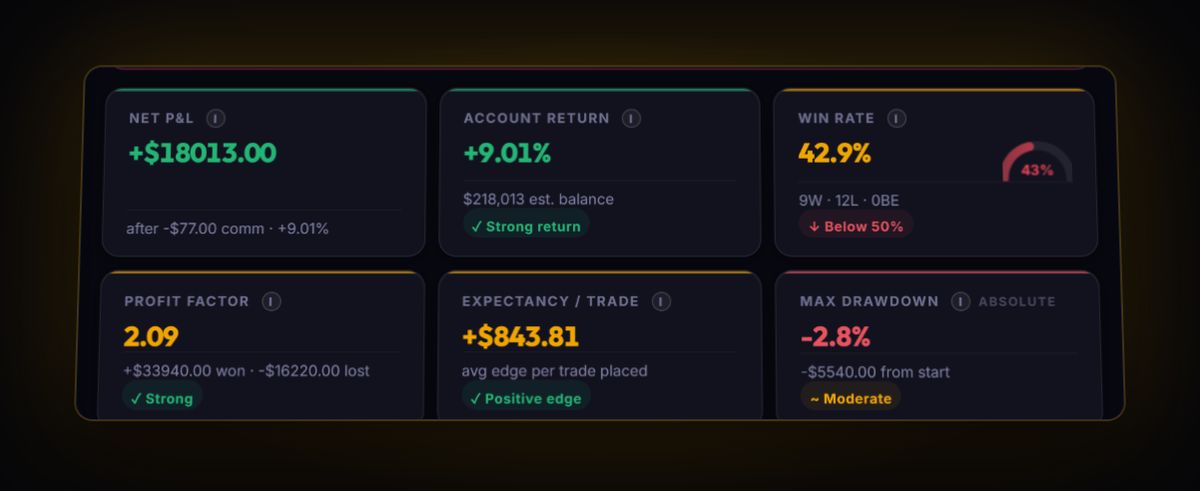
Turn these terms into your own numbers
The RB Trading journal works out R, expectancy, profit factor, drawdown and your prop rule room from the trades you log, import or live-sync from MT4, MT5 and cTrader.
Start free, no card