How to track a position you scale into, one entry at a time
Decide the total risk for the whole position first, split it across the entries, and size each entry from its own distance to the stop. Then measure the finished position as one trade: profit divided by the risk you actually took. Tracked this way, scaling in is a plan. Tracked loosely, it is averaging down with extra steps.
Last checked: 8 October 2026. Education only, not personal investment advice.
Scaling in means building a position in pieces rather than all at once. Investors do it because they rarely know the exact low, and because buying in thirds makes it easier to act at all. The risk is that each add feels like a fresh decision with fresh money, so the total size creeps far beyond what you would have taken in one go. The fix is to treat the entries as parts of one plan with one budget.
Step one: one budget, split evenly
Portfolio: $50,000. You are willing to lose 1.5% on this idea, so the budget is $750. You plan three entries, so each one may risk $250. The thesis is wrong below $90, so every entry shares that stop.
| Entry | Price | Risk per share | Shares | Risk |
|---|---|---|---|---|
| 1 | $100 | $10 | 25 | $250 |
| 2 | $96 | $6 | 41 | $246 |
| 3 | $93 | $3 | 83 | $249 |
| Total | 149 | $745 |
Shares are rounded down so no entry goes over budget. Total cost is $2,500 + $3,936 + $7,719 = $14,155, so the weighted average entry is $14,155 ÷ 149 = $95.00.
Notice what equal risk does. The entry closest to the stop gets the most shares, because each share there can only lose $3. Your average entry lands near the lower prices, which is where you wanted to be buying. And no matter how many entries fill, the most you can lose is the budget.
Step two: measure the whole position, not each leg
If the stock reaches your target of $120 and you sell all 149 shares, the proceeds are $17,880 and the profit is $17,880 − $14,155 = $3,725. On $745 of risk that is 5.0R.
If the stock instead closes below $90 after all three filled, you lose $745, which is −1.0R. That is the same loss you accepted before the first share was bought.
And if only the first entry filled before the stock ran to $120? Profit is 25 × $20 = $500 on $250 of risk taken: 2.0R. Measure R on the risk you actually took, not the risk you planned. Otherwise a position that never got built looks like a failure when it was a perfectly good small win.
Scaling into a winner instead
The other way to scale in is to add as the trade proves itself: buy a starter, then add after a higher low forms, raising the stop each time. It costs a worse average price but you only add size to positions that are already working. The journal treatment is the same. Each add has its own entry and stop, the group shares one budget, and the finished position is judged in R on the total risk taken.
The one rule that keeps this honest
An add that was not in the plan is a new decision, and it needs a new line in the journal saying why. "It is cheaper now" is not a reason. It is a description. If the stop moves lower to make room for another add, write that down, because that is the single most expensive habit in investing.
How the RB Trading journal handles scaled entries
This is what the DCA / Split Entries tab on Add Trade was built for.
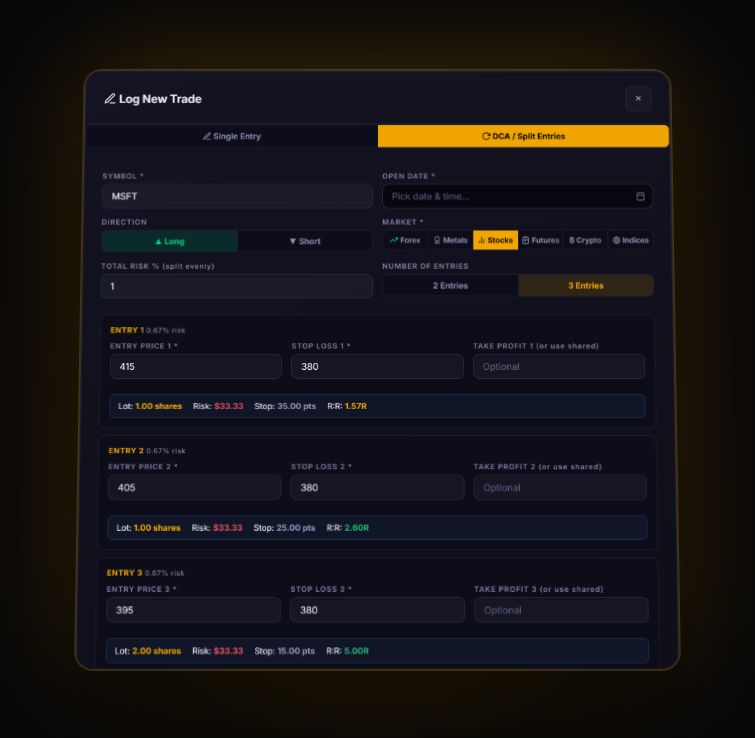
- Choose two or three entries and set the total risk percentage. The journal splits it evenly and shows each entry’s share of the risk.
- Type each entry’s price and stop. The journal sizes each entry from your account balance and shows the stop, size and risk under it.
- Add a shared take profit, or a separate one per entry. The reward to risk updates per entry as you type.
- Save. The entries are stored as one DCA group, so your stats count one position, and its R is the size-weighted R across every entry and exit.
Already holding a position and want to add? Open the trade, switch to the split-entry tab, and the journal offers to carry your open position in as Entry 1. It keeps the size you already hold, and the risk percentage sizes only the new entries. A closed trade cannot be added to, because that would invent history that never happened.
Scaling-in questions
Is scaling in the same as averaging down?
Not if the stop and the total risk are fixed before the first entry. Averaging down becomes dangerous when each new buy comes with a lower exit level or extra money that was never budgeted.
How do I calculate the average entry price of a scaled position?
Add up the cost of every entry and divide by the total number of shares. In the example, $14,155 divided by 149 shares gives $95.00.
Should every entry risk the same amount?
It is the simplest rule and the one the journal uses: the total risk is split evenly. Equal risk naturally puts more shares at the entries closest to the stop.
Track it in a journal that does the maths
Log the trade once. R, fees and the weighted average entry are worked out for you.
Start free, no card