How to journal long-term stock positions you hold for months
Journal a long-term position as one trade with four things written down before you buy: why you own it, the price or event that proves you wrong, how much of the portfolio you are putting on the line, and the date you will look at it again. Without those four, a long hold drifts into a position you keep because selling feels like admitting a mistake.
Last checked: 8 October 2026. Education only, not personal investment advice.
Most investors keep a spreadsheet of tickers, share counts and an average cost. That tells you what you own. It does not tell you whether your decisions are any good, because nothing in it records what you expected when you bought. A journal fixes that. The question it answers a year later is not "am I up?" but "did this go the way I said it would, and was the size right?"
The four lines you write before you buy
Keep each one short. If you cannot fit the reason in three sentences you do not have a reason yet, you have a feeling about a company.
- Thesis. What has to happen for this to work. "Margins keep expanding as the software segment grows past half of revenue" is a thesis. "Great company" is not.
- Invalidation. A price level, an event, or both. A price level is easier to act on: a weekly close below the 200-week EMA, or below the last major swing low. An event example: the segment you bought it for shrinks two quarters in a row.
- Size and risk. The share count, the percentage of the portfolio, and the money you lose if the invalidation level is hit. That last number is your 1R for the position.
- Review date. When you will reread the thesis. For most holdings, after each earnings report or once a quarter.
Why R still matters when you hold for a year
R is just the result divided by the amount you planned to risk. Traders use it on five-minute trades, but it is even more useful on long holds, because it stops a big percentage gain on a tiny position from looking like skill, and a modest percentage gain on a properly sized position from looking like nothing.
Portfolio value: $60,000. You buy 120 shares at $85.00, a position of $10,200, or 17% of the portfolio.
Your invalidation is a weekly close below $72.00, where the stock would sit under its 200-week EMA. Risk per share is $85.00 − $72.00 = $13.00, so the money at risk is 120 × $13.00 = $1,560, which is 2.6% of the portfolio. That $1,560 is 1R.
Fourteen months later the stock is at $118.00. The open gain is 120 × ($118 − $85) = $3,960, which is $3,960 ÷ $1,560 = 2.54R. As a percentage it is 38.8% on the position.
Now compare a second holding: 30 shares bought at $40 with a stop at $30, so 1R is $300. It doubles to $80. That is a 100% gain, but only $1,200, or 4R. The percentage made it look like your best idea. In money it was about a third of the first.
Once you see results this way you start asking the right question: not "which stock went up most" but "where did I put real size, and was I right there?"
What else to record while you hold
A long hold produces events, and those events are where the lessons sit. Add a short dated note each time one of these happens:
- Earnings. One line on whether the result supports the thesis. Do not paste the press release.
- Dividends received. Note the amount and date. Total return is price change plus dividends, and over several years the second part can be large.
- Adds and trims. Every time you buy more or sell some, record the price, the share count and the reason. These are separate decisions and deserve separate scrutiny.
- Moving the invalidation level. If you raise your exit level as the trend develops, write the new level and why. Lowering it is the warning sign. If you catch yourself lowering it, write that down too.
A simple entry layout
| Field | Example |
|---|---|
| Ticker and date | Example Corp, 4 Aug 2025 |
| Entry | 120 @ $85.00 |
| Invalidation | Weekly close under $72.00 |
| 1R | $1,560 (2.6% of portfolio) |
| Thesis | Software segment passes 50% of revenue, margins expand |
| Review | After each quarterly report |
| Strategy tag | Core hold |
How to track it in the RB Trading journal
The journal was built for active traders, but everything you need for a long hold is already in it.
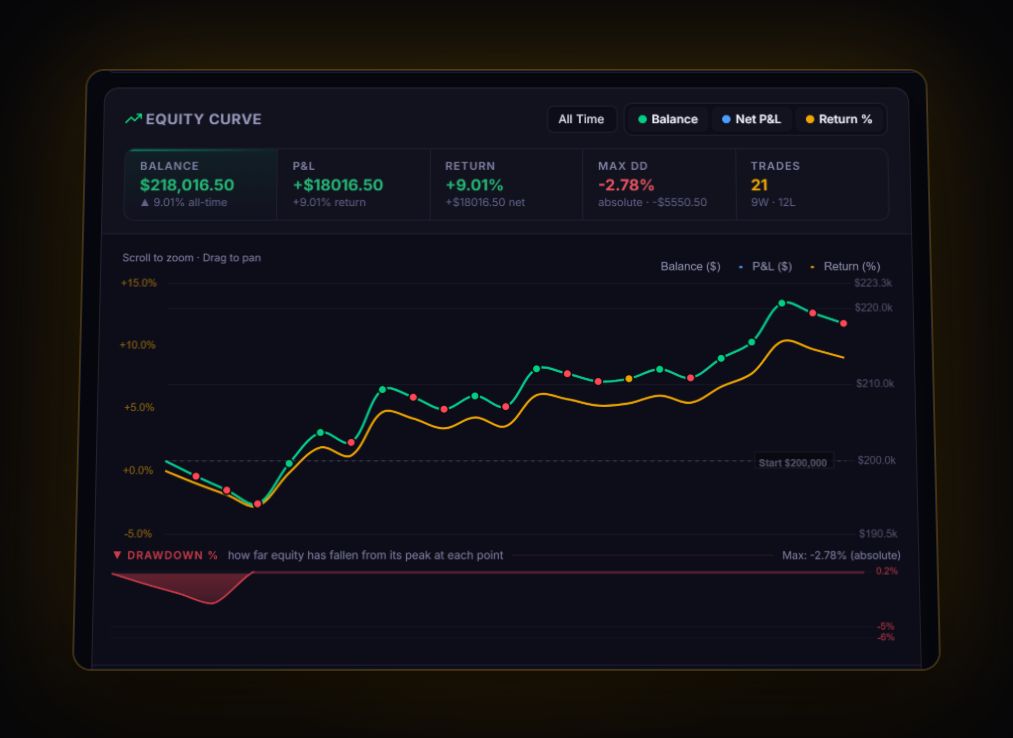
- Market set to Stocks and the account’s leverage basis set to Cash, no margin (1:1), so buying-power warnings match a normal investing account.
- A separate account for long-term holdings. The journal supports multiple accounts, so your core portfolio does not mix with swing trades or a prop challenge. The All Accounts view combines them when you want the full picture.
- Entry, stop and size on the trade give you R automatically. Your invalidation level goes in the stop field even if you never place a live stop order.
- Strategy tags such as "Core hold" or "Dividend" let you filter results by approach later.
- Notes and screenshots on the trade hold the thesis and each dated update, so the reasoning lives next to the numbers.
- Adds go through the split-entry panel, covered in tracking a position you scale into.
The journal does not have a dividend field. Record dividends in the trade notes and add them to your own total-return figure.
Questions investors ask
Do I need a stop loss on a long-term stock position?
You need an invalidation level, written down before you buy. Whether you place it as a live order is up to you. Many investors use a weekly closing level instead of an intraday stop, so a single bad day does not shake them out.
How often should I update a long-term journal entry?
At every event that tests the thesis: earnings, a large add or trim, a change to your exit level. In between, once a quarter is enough. Daily checking tends to produce trades you did not plan.
Can I use R-multiples for buy-and-hold investing?
Yes. Divide the gain or loss by the money you would lose if your invalidation level were hit. It lets you compare a small position that doubled with a large one that rose 30 percent on equal terms.
Track it in a journal that does the maths
Log the trade once. R, fees and the weighted average entry are worked out for you.
Start free, no card