The formula
The fractions must add up to 1, and every R is measured from the original stop on the full position.
A worked example
Long 1 lot. You close 0.5 at +1R, move the stop to break-even, and the other 0.5 later exits at +3R:
Now compare plans across 100 trades. Say 30 run to +3R, 25 reach +1R then reverse to the stop, and 45 never reach +1R.
| Plan | Calculation | Expectancy | Win rate |
|---|---|---|---|
| All out at 3R | 0.30 × 3 − 0.70 × 1 | +0.20R | 30% |
| Half at 1R, rest to 3R | 0.30 × 2 + 0.25 × 0.5 − 0.45 × 1 | +0.275R | 55% |
Here scaling out wins, because a quarter of trades reach +1R and then fail. If almost every trade that reaches +1R carried on to +3R, the all-out plan would win. Your MFE data tells you which world you trade in.
Common mistakes
- Counting each leg as a trade. One position closed in three parts is one trade. Counting legs inflates win rate and trade count.
- Measuring R on the remaining size. R always comes from the original risk on the full position.
- Moving to break-even too early. It turns many would-be winners into scratches.
How the RB journal tracks it
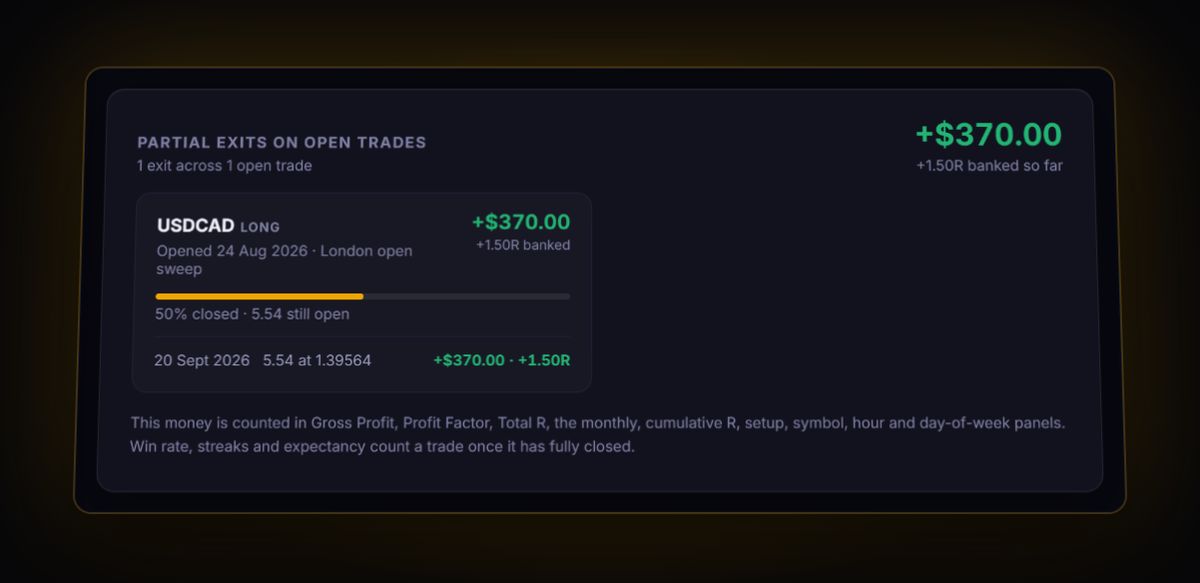
The journal treats scale-out legs as one trade: with the RBSync EA 1.14 or later on MT5, a position's partial closes fold into a single trade with a blended result, so win rate, profit factor and SQN stay honest. Avg MFE and TP Capture % show whether your runners are worth keeping.
See your own Scaling Out from real trades
Log trades by hand, import a file, or live-sync MT4, MT5 and cTrader through the RBSync EA. The numbers on this page then come from your own history instead of examples.
Start free, no card