Futures trading journal: ticks, contract value and the trailing drawdown
A futures journal has two jobs a forex or stock journal does not. First, it has to turn points into dollars correctly, because every contract has its own tick size and tick value, and the micro looks almost identical to the full-size contract on a chart. Second, if you trade a prop evaluation, it has to track a drawdown floor that moves up behind you as your equity rises. Log ticks, contracts, fees per round turn and your distance from that floor on every trade, and the rest of your analysis gets much easier.
Tick values you should know by heart
Futures P&L is simple once you have the contract's numbers: points moved, times the dollar value of one point, times the number of contracts. The trap is mixing contracts up. One ES contract is ten MES contracts, so an order typed with the wrong root is a tenfold size mistake. Here are the specifications for the contracts prop traders use most, from CME Group's contract pages.
| Contract | Tick size | Tick value | One full point |
|---|---|---|---|
| ES, E-mini S&P 500 | 0.25 | $12.50 | $50 |
| MES, Micro E-mini S&P 500 | 0.25 | $1.25 | $5 |
| NQ, E-mini Nasdaq-100 | 0.25 | $5.00 | $20 |
| MNQ, Micro E-mini Nasdaq-100 | 0.25 | $0.50 | $2 |
| CL, Crude Oil | 0.01 | $10.00 | $1,000 |
| GC, Gold | 0.10 | $10.00 | $100 |
Log the root symbol (ES) as well as the full contract month (ESZ6). When the contract rolls every quarter, a journal that only knows ESZ6 and ESH7 will split one market into two lines in your stats.
What to record on every futures trade
- Contract root and month, so stats group by market and survive the roll.
- Number of contracts, and whether they were micros or minis.
- Ticks gained or lost, not just dollars. Ticks show whether your read is improving even while size changes.
- Fees per round turn. Exchange, clearing and platform fees are small per contract and large per month for a scalper.
- Best and worst price during the trade (MFE and MAE). On an intraday trailing drawdown, the best price matters even if you never banked it.
- Distance to the drawdown floor before you entered, and the time of day.
A worked day on a 50K evaluation
Example numbers, not any firm's rule
Take a 50,000 dollar evaluation with a 2,000 dollar trailing drawdown, so the floor starts at 48,000. Fees here are an example 4 dollars per ES round turn and 1 dollar per MES round turn. Three trades:
| # | Trade | Points | Ticks | Gross | Fees | Net | Balance |
|---|---|---|---|---|---|---|---|
| 1 | Long 1 ES | +6.00 | +24 | +$300 | $4 | +$296 | $50,296 |
| 2 | Short 4 MES | -5.00 | -20 | -$100 | $4 | -$104 | $50,192 |
| 3 | Long 2 MES | +12.00 | +48 | +$120 | $2 | +$118 | $50,310 |
A green day, +310 dollars. Now the part most traders never write down. Trade 1 was up 10 points, 500 dollars, at its best before you closed it at +6. What that does to your floor depends on how the firm trails it:
- Intraday trailing, following the highest equity reached, unrealised included: the peak was 50,500, so the floor moved to 48,500. You end the day with 1,810 dollars of room.
- End of day trailing, following the closing balance: the floor moves once, to 50,310 minus 2,000, which is 48,310. You end the day with the full 2,000 dollars of room.
Same trades, same profit, 190 dollars less room under the intraday rule, all because a winner gave back four points. Repeat that a few times a week and the floor catches you on a day that never felt dangerous. Many firms also stop trailing once the floor reaches the starting balance. The exact rule is on each firm's page, for example Topstep or Apex Trader Funding, and the difference between the two styles is laid out in trailing versus static drawdown.
The futures metrics that matter
- Net per contract after fees. If a setup averages two ticks on MES, fees take a large slice of it.
- Average ticks on winners and on losers. Cleaner than dollars when your size changes between micros and minis.
- Giveback from MFE. How much open profit winners return before you close them. On an intraday trailing drawdown this is a direct cost.
- Result by contract. Many traders are steady on ES and erratic on NQ or CL, whose moves are larger for the same chart pattern.
- Result by half hour. The open of the regular session behaves very differently from the lunch hour.
- Daily loss limit hits and consistency, if your firm has those rules.
Mistakes the futures journal surfaces
The jump from micros to minis. After a good week, moving from 5 MES to 1 ES looks like a small step. It is the same exposure as 10 MES, double what you traded. A contracts column makes this visible straight away.
Scalps that only work before fees. Gross P&L can look positive while net is flat. Journal net, always.
Winners left to fade. On an intraday trailing account, a trade that went +10 points and closed at +2 still lifted your floor as if you had banked all 10 points, provided that peak was a new equity high. Logging MFE turns this from a feeling into a number.
Evaluation and funded trades mixed together. Keep each account separate. The rules, and often your behaviour, differ between them.
How the RB journal handles futures
Futures platforms come in by file, not live sync. NinjaTrader and Tradovate files have their own parsers. Other platforms, including Rithmic-based ones, go through the generic CSV mapper: prefer a file with a dollar result per trade, and check the first few trades against your statement. Live sync covers MT4, MT5 and cTrader only.
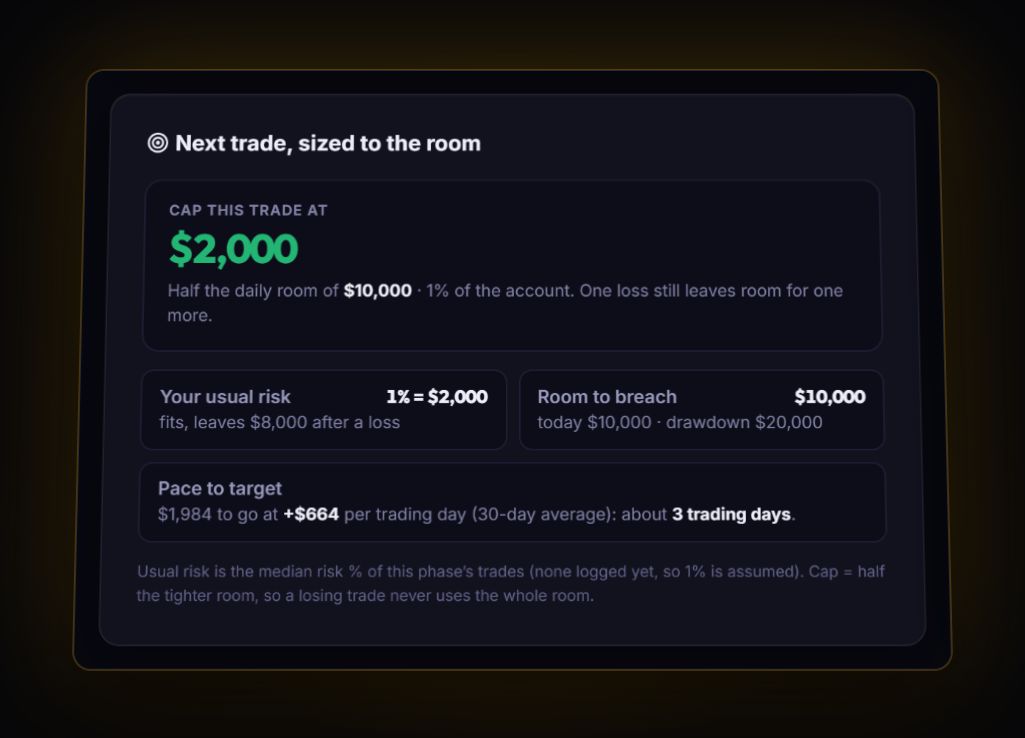
The prop tracker is where the futures side earns its place. You set the account's drawdown as trailing (rising with the equity peak), end of day (from the daily balance) or static, along with the daily loss limit and profit target, and it shows your room to the floor and a cap for the next trade. The Risk Manager meters today's loss against your limit, and the consistency check shows your best day as a share of total profit. Platform guides cover the export steps for NinjaTrader, Tradovate, Topstep accounts and Rithmic. To test how much room a rule really leaves, try the prop firm drawdown calculator. Comparing tools? See how we line up against TradesViz.
Quick answers
What is the tick value of ES and MES?
ES moves in 0.25 point ticks worth 12.50 dollars, so a full point is 50 dollars. MES has the same tick size at one tenth of the value: 1.25 dollars a tick and 5 dollars a point.
How does a trailing drawdown affect my futures journal?
On an intraday trailing drawdown the floor follows your highest equity, including open profit, so a winner that gives back ticks still raises the floor. Log the best price on each trade and your distance to the floor to see this happening.
Can the RB journal sync NinjaTrader or Tradovate live?
No. NinjaTrader and Tradovate trades come in by file import, each with its own parser. Live sync covers MT4, MT5 and cTrader through RBSync.
Sources
- CME Group: E-mini S&P 500 contract specs
- CME Group: Micro E-mini S&P 500 contract specs
- CME Group: E-mini Nasdaq-100 contract specs
- CME Group: Crude Oil (CL) contract specs
- CME Group: Gold (GC) contract specs
Last checked: 9 October 2026. Exchanges rarely change tick sizes, but prop firm drawdown rules change often, so confirm the current rule on your firm's own site before you trade it.
Know your room before the next trade
Import your NinjaTrader or Tradovate file and set your firm's drawdown style. The free plan holds 50 trades.
Start free, no card