Forex trading journal: pips, lots and the session you traded
A forex journal pays for itself when it records what a closed P&L number hides: how many pips your stop was, what lot size turned those pips into money, which session you traded in, and what spread and swap cost you. Log those five things on every trade and within a few weeks you can see which pairs and which hours actually pay you. This page covers what to record, a worked week with example numbers, the metrics that matter for currency traders, and how the RB journal brings in MT4, MT5 and cTrader trades.
Pips tell you if the idea worked. Money tells you if the sizing did.
Two trades can both win 20 pips and mean completely different things. One was 0.10 lots with a 15 pip stop, the other was 2.00 lots with a 60 pip stop. Same pip result, very different risk. That is why a forex journal needs both columns, plus a third that ties them together: the result in R, meaning the result divided by what you planned to lose.
Quick refresher on the units. A pip is 0.0001 on most pairs and 0.01 on yen pairs. A standard lot is 100,000 units of the base currency, a mini lot 10,000 and a micro lot 1,000. On pairs quoted in US dollars, such as EURUSD or GBPUSD, one standard lot moves about 10 USD per pip. On everything else the pip value floats with the exchange rate, which is exactly why logging the money result next to the pips matters.
What to record on every forex trade
| Field | Why it matters in forex |
|---|---|
| Pair and direction | Your edge is rarely equal across pairs. Some traders are fine on EURUSD and bleed on GBPJPY. |
| Stop distance in pips | Lets you check that the lot size matched the stop, not the other way round. |
| Lot size | Spots size creep after a winning streak or a losing day. |
| Risk in account currency | The denominator for R. Without it, results across pairs cannot be compared. |
| Session | Asia, London, New York or the London and New York overlap. Liquidity and range differ a lot between them. |
| Spread and commission | On short-term trades these can eat a real share of the profit. |
| Swap | Holding past the daily rollover costs or pays you. On multi-day trades it adds up. |
| Setup tag and a screenshot | So you can later ask which setup carries the account. |
A worked week, step by step
Example numbers, not a real account
Picture a 10,000 USD account risking 1%, so 100 USD, per trade. The lot size changes every trade because the stop distance does. For the yen cross we assume USDJPY at 150, which makes one standard lot of GBPJPY worth roughly 6.67 USD per pip.
| # | Pair | Session | Stop | Lots | Pips | USD | R |
|---|---|---|---|---|---|---|---|
| 1 | EURUSD | London | 25 | 0.40 | +50 | +200 | +2.0 |
| 2 | GBPJPY | Asia | 40 | 0.37 | -40 | -99 | -1.0 |
| 3 | EURUSD | New York | 20 | 0.50 | -20 | -100 | -1.0 |
| 4 | GBPUSD | London | 30 | 0.33 | +45 | +149 | +1.5 |
| 5 | AUDUSD | Asia | 15 | 0.66 | -15 | -99 | -1.0 |
| 6 | EURUSD | Overlap | 20 | 0.50 | +30 | +150 | +1.5 |
The week ends at +50 pips, about +200 USD and +2.0R. Fine, but the totals are not the lesson. Split the same six trades by session and a pattern shows: London and the overlap made +5.0R between them, Asia lost 2.0R and New York lost 1.0R. Six trades prove nothing on their own. If that split still looks the same after fifty trades, the fix is to stop trading the Asian session, not to hunt for a new strategy.
Notice also that a pip total would have misled you. The GBPJPY loss was 40 pips and the AUDUSD loss was 15, yet both cost exactly 1R because the size was set from the stop. Judge forex trades in R and the pairs become comparable.
The forex metrics worth watching
- Result by session. The single most useful forex cut. Most currency traders have one session where they are clearly better.
- Result by pair. Drop the pairs that cost you money over a meaningful sample, even if they feel familiar.
- Expectancy in R. Average R per trade. Positive and stable is the goal, not a high win rate.
- Cost share. Spread, commission and swap as a share of gross profit. If a scalping style gives a third of its gross back in costs, the style needs a cheaper account or longer targets.
- Average win against average loss in R. If losers run past 1R, stops are being moved.
Mistakes a forex journal catches early
Sizing by habit
Trading 1.00 lot every time feels consistent, but it means your risk swings with the stop distance. A 15 pip stop risks 150 USD and a 60 pip stop risks 600 USD. In the journal it shows up as an R column that is all over the place. Size from the stop with a position size calculator instead.
Three bets on the same currency
Long EURUSD, long GBPUSD and short USDJPY at the same time is one big bet against the dollar. If your journal shows clusters of losses closing within minutes of each other, check whether they shared a currency.
Swap you never noticed
Positions held past the broker's daily rollover pay or earn swap, and most brokers charge three days of it on one night in the middle of the week to cover the weekend. Check your broker's swap table. A journal that stores swap per trade shows what holding really costs.
Server time that skews your sessions
Many MetaTrader servers run on GMT+2 or GMT+3. If your journal reads those times as UTC, a London trade lands in the wrong session and your session stats describe someone else. Our best trading hours guide covers when each session actually moves.
How the RB journal handles forex
MT4, MT5 and cTrader: the RBSync EA (a cBot on cTrader) sends each trade to the journal as it closes, with lots, commission and swap, and its server offset turns broker time into UTC. Everything else: import a file. The importer reads MT4 and MT5 statements, cTrader, DXtrade and prop firm exports, and the generic CSV mapper covers other brokers once you tag the columns.
Once trades are in, the journal does the forex-specific work for you:
- Session tagging. Each trade's session is detected from its open time as Asia, London, New York or the London and New York overlap, and you can override it.
- Swap per trade. A swap and overnight field sits on every trade, filled by the sync or typed in by hand.
- Time views. A time of day heatmap, P&L by weekday and results by session show where your week is won and lost.
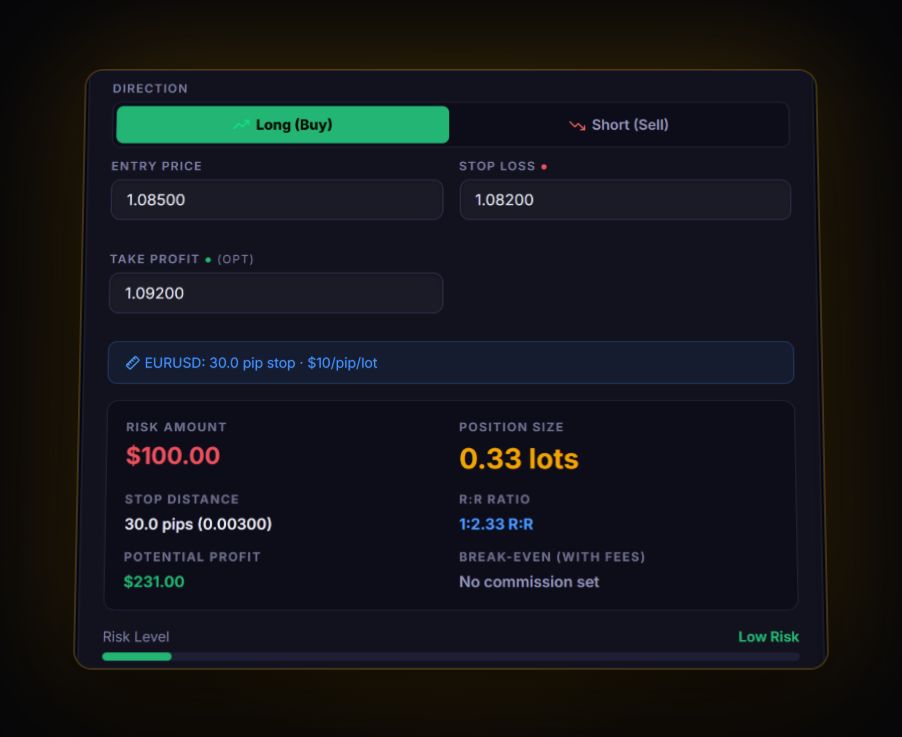
- Sizing. The built-in calculator turns your stop in pips and your risk into a lot size before you click buy.
- Prop accounts. If you trade a forex evaluation, the prop tracker watches the daily loss limit and the drawdown floor. Check the rules for FunderPro or Fintokei before you set it up.
Not sure your broker is covered? The broker guides list the export route for over thirty brokers, from IC Markets to OANDA. And if you are weighing up tools, here is how we compare with TradeZella.
Quick answers
What should I record in a forex trading journal?
The pair, direction, entry and exit, stop distance in pips, lot size, money at risk, the session, spread, commission and swap, plus a setup tag. The result in R ties them together so different pairs can be compared.
Should I track forex results in pips or in money?
Both, and then in R. Pips show whether the read was right, money shows whether the size was right, and R (the result divided by the planned risk) makes trades on different pairs comparable.
Can the RB journal sync MT4, MT5 or cTrader automatically?
Yes. The RBSync EA for MT4 and MT5, and the RBSync cBot for cTrader, send each closed trade to the journal. Other brokers come in by file import or the generic CSV mapper.
See your best session in a week
Sync MT4, MT5 or cTrader, or drop in a statement. The free plan holds your first 50 trades.
Start free, no card